The State of Crypto Banking in 2025
The financial system in 2025 looks nothing like it did a decade ago. Where banks once dominated and no one cared about ‘crypto’, the two worlds are now converging at speed.
What was once speculative is becoming a big deal in the financial world, and what was once dismissed as ‘scam’ is now embedded into the future of money.
Crypto banking has moved from concept to reality.
Stablecoins are powering payments, cross-border transfers are increasingly handled on-chain, and institutions that once watched from the sidelines are actively building in the space.
Visa, for example, is piloting stablecoin-powered settlement solutions, demonstrating how digital currencies can outperform traditional networks like SWIFT in speed and efficiency.
Major banks are experimenting with tokenized assets and digital currencies of their own, while mergers and acquisitions among crypto-native platforms have created an era of consolidation.
Crypto Regulation in 2025
This transformation has not come without rules obviously. 2025 is the year when regulation became key.
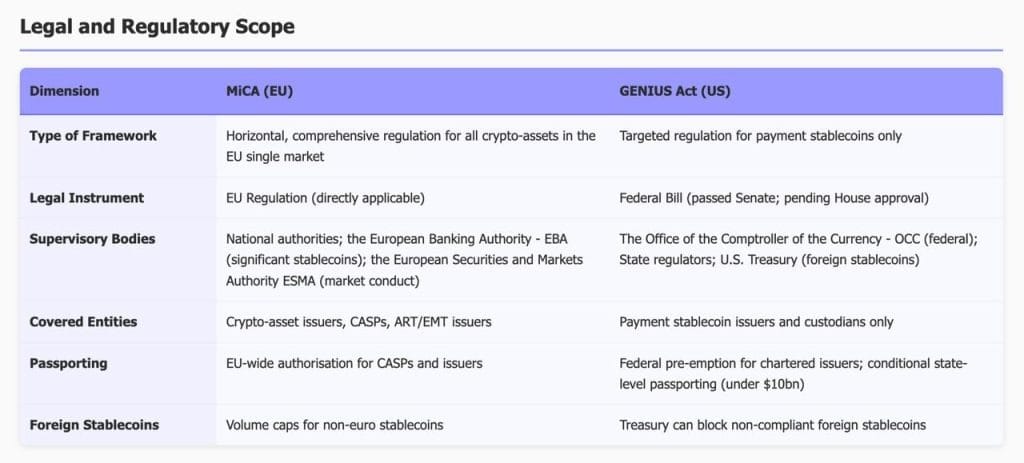
The European Union’s MiCA framework has gone live, creating one of the most comprehensive rulebooks for crypto assets anywhere in the world. Platforms are now required to obtain licenses as Virtual Asset Service Providers, maintain transparent reserves, and comply with strict AML and KYC standards.
Similar rules are appearing globally, bringing crypto and banking under one regulatory umbrella for the first time.
Major Players Enter the Space
The list of dominant players in crypto banking is growing.
Coinbase, Binance, and Kraken are no longer just trading venues but are evolving into full-service financial platforms offering custody, lending, and payment solutions.
Circle’s USDC has become the benchmark for regulated stablecoins, offering transparency and reliability for global payments. Even Visa and Mastercard have stepped fully into the space, integrating stablecoin rails into their global networks.
Traditional banks like HSBC and Santander are cautiously experimenting with tokenized securities, slowly moving from observers to participants.
In this landscape, new entrants are not just competing but redefining what a crypto bank can be.
Enter, BxLend
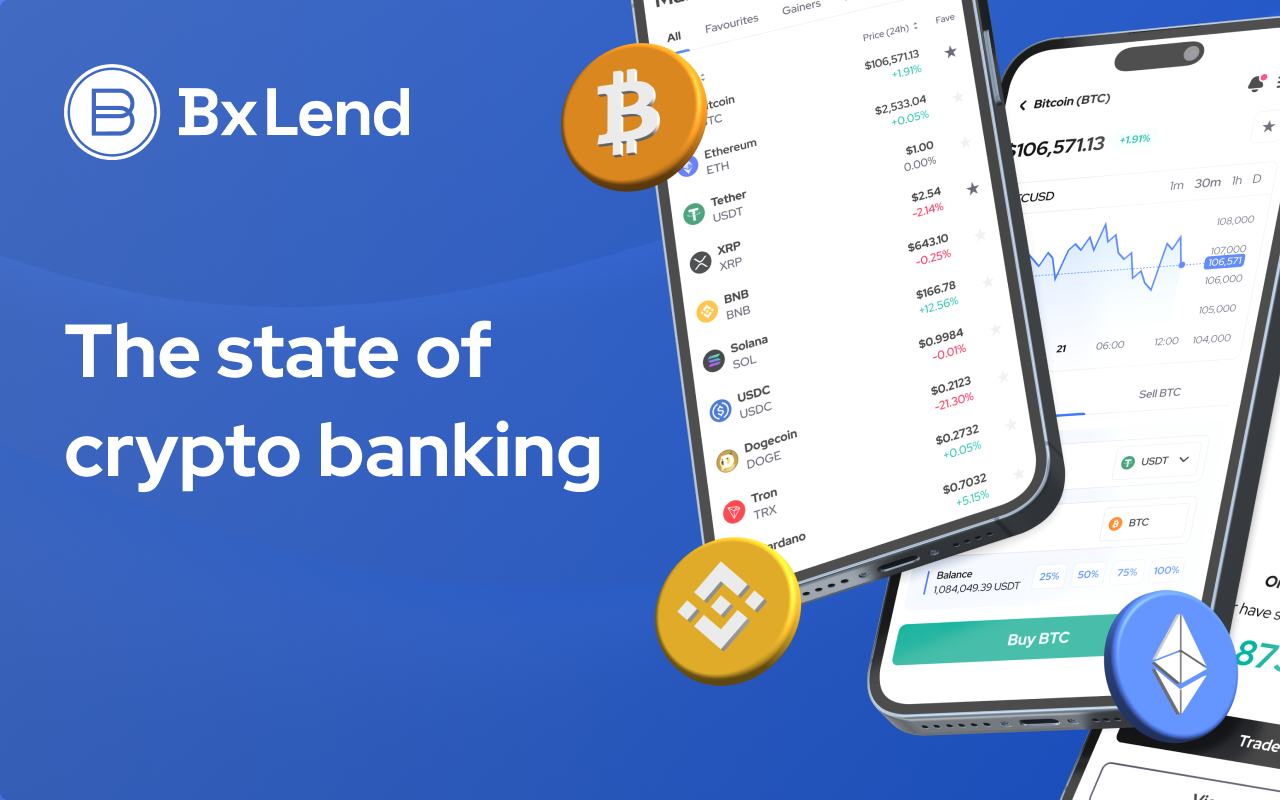
BXLend is one of the most notable examples. Unlike platforms that lean too heavily on either traditional finance or decentralized finance, BXLend combines both into a single ecosystem.
Users can trade crypto with institutional-level liquidity, deposit and withdraw euros seamlessly through SEPA, and spend their digital assets in the real world using crypto cards and ATM access.
It also offers lending and savings products across more than a hundred cryptocurrencies, giving customers the chance to grow wealth without liquidating their assets.
Crucially, all of this is built on a foundation of trust, with full EU compliance, VASP licensing, and the kind of regulatory rigor that ensures long-term sustainability.
The narrative of crypto banking in 2025 is no longer about possibility but inevitability.
What began as an experiment in peer-to-peer money has matured into a global financial system. Stablecoins are now a core part of payments infrastructure.
Exchanges are no longer just for traders, but for everyday users who want to save, spend, and borrow. And platforms like BXLend are showing that the future of banking may not be about choosing between fiat and crypto at all, but about uniting the two into one seamless experience.
Conclusion
The conclusion is simple: crypto banking is no longer knocking at the door. It has stepped inside, taken a seat at the table, and is helping to redraw the map of global finance.